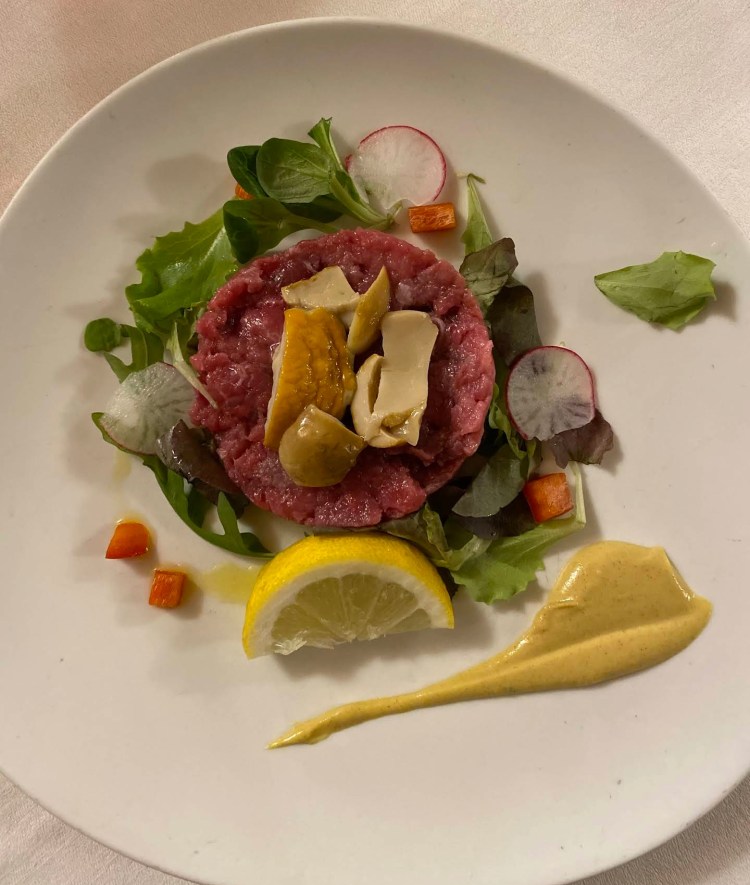
Fassona tartare, a Piemontese specialty
I’ve often thought what I’d be writing about once I was finally able to return to this great passion. There were times during these past five years that I was tempted by a particular (i.e. sensational) wine’s grace and form; I even pictured myself writing the note that I’d begun to write after I was sure what was in my glass was the real deal. And by that I mean that over the course of the glass, or the bottle, or twenty minutes, or two hours, whatever it took for the wine to have a complete voice; a beautiful and highly memorable message, if you will.
Not unlike the wines that require time to transform (think: from a block of stone into a profound sculpture) I, too, had to walk far enough on this unfortunate path, (one strewn with one challenge after another) before I, too, had tranformed, become more complete. Without getting into messy details, I’ll just say that I’m glad it’s behind me, that I finally have something(s) to look forward too, again; it’s been a while.
That said, I’ve decided to once again walk the well-worn path of spring wine fairs in Europe. I’ll start with Chianti Classico Collection in Florence in February, spend a week in Dusselforf/Cologne during Tre Bicchiere and ProWein in March, and wrap up with ViniVeri and perhaps visit VinItaly (Verona) on the event’s final day in April; all travel has already been booked and paid for, a strong incentive to keep the motivation and discipline on track. I’ve got lot of notes and features to catch up on.
The above paragraph is meant to reference time, an important part of the complete story, in my opinion; every wine has a time factor, some less than others as the vintage a/o material dictates. In the case of fine wines, it’s the unknown, the unimagined and the dose(s) of reality along the way that help guide, and as with many fine wines, lend that essential component helping to render our experience, our take aways, if you will.
I mention these things because in 2011, after having visited my second or third VinItaly, I tasted a wine that imparted a profound message – and it was only a few hundred meters from where I was lodged for several months in La Morra comune. It happened to be a winery I’d not heard of/tasted before, most probably because of limited distribution in the USA. After tasting it and listening to its message, it was but a few days that I decided to walk to that cantina, introduce myself and buy the wine; I absolutely had to have it in my cellar; I left with two paper-wrapped magnums. It would be nearly twenty years before I opened the first of them, and I was keen to see if what I predicted would happen, did happen. Specifically, I needed to see if the structure, the beauty and the depth had all reached a plateau of greatness that the wine foretold that day while tasting at VinItaly so many years ago. It had.; And, as a bonus, I was with good friends, good food,etc. and the waters of my life were once again serene, comfortable, and rewarding.
You, too, may have never heard of this wine. I’d be willing to wager that if the winemaker (Marco Oberto, in La Morra) at any point decided that a particular wine was worthy of Riserva, it would not disappoint, not even a little; so you may want to include this wine in your future hunts. For context the magnum of 2004 Ciabot Berton Barolo Riserva was treated as follows: removed the cork the night before to inspect/rule out TCA/other; I left the cork out for 20 hours until aerating in wide-bottom decanter for one hour just prior to serving on day two.
After removing the cork and pouring ~ 1,5oz sample, I observed the nose (sound, no flaws) and then gave the sample glass a swirl and re-smelled in a few minutes later. At this point, I decided to let the 1,5oz sample glass sit and aerate for 45 minutes, as I tend to find many clues relevant to the aeration I ultimately wanted to allow the wine prior to service. A few more swirls, sniffs and small tastes suggested this needed air, but in a more controlled manner vs the substantial surface area exposure the bottom decanter provides. I mention all of this because over the past twenty years, a lot of people have asked me about the best way to serve older Barolo/Barbaresco wines. The way that works for me (there is no universal, i.e. best, method, they’re all living things and should be approached as such) is to listen in these ways; you may find some value to this methodology. 
If trying to guess the age of the wine were done on its color alone, this would suggest it’s quite young; no/very little browning near the meniscus. The aromas are complex, with a rather varied set of fruit, soil and age-related aromas. On this particular evening, the wine began with about an even mixture of place and fruit notes, but by the end of the bottle, the fruit notes had (at least) doubled in beauty and intensity. By the mid-way point, the wine offered vivid, classic red fruit notes (~65%) and bright, inviting notes of place/time (e.g. soil, forest, a fring of tar).
Having looked at it and smelled it, there was only one thing left to do — I was giddy with anticipation. Really. The build is a classic medium body with some moments here and there that offered a bit more depth/width. The acids were pitch perfect, fresh and integrated. The finish was medium+ upon opening and had moved to long/full by the end of the magnum; the fine, sweet tannins were confidently caressing. The well-experienced crew at the dinner were all (tends to be rare in my experience) in agreement, this was a genuine, elegant beauty.
Now that I’ve shared my experience, it’s time for me to give Marco a call and find out how he’s farming these days (e.g. bio or conventional); I have a pretty good idea, but it’s worth finding out. I also want to thank him for this fabulous creation.
 ItalianWine.blog
Good to see you writing again, my friend!
LikeLike
Hey, good to read you, brother. Happy Thanksgiving. Let’s catch up soon. In CO for a few weeks only to sell my two cars (still waiting, have only 15 days remaining) and then I’m in the wind.
be well
LikeLike
Glad you are back Tim and that life is much better for you. I look forward to reading your wine reviews and stories of the wine road.
Craig Johnson Blossom20
LikeLike
Many thanks, Craig. Yes, the wine road, I intend for it to be as well worn as this keyboard come this time next year. Fingers crossed. Thanks for reading, and commenting; I’ll try to keep things interesting.
stammi bene
LikeLike
Great to have you back!
I used to really look forward to seeing your articles and tasting notes on cellartracker.
Onwards and upwards!
Regards,
Brett H
LikeLike
Very kind words, Brett, thanks for reading. And yes, I’ll keep moving forward. Thankfully, there’s no shortage of things to write about in these strange days; it’s become commonplace now to see a weekly dispatch of yet another massive amount of vines being ripped out, seemingly, for good, etc.
be well
LikeLike
Tim! So good to have you back recovered (at least enough to write) and posting again!
I have excellent memories of our lunch at La Torre, in Cherasco.
We are now spending 6 months a year in Paris (renting of course :)) and so I will reach out next year and see where you will be, maybe a trip to italy is in order for another lunch??
Take care!
LikeLike
Thanks, John, it’s nice to hear from you. I, too, am doing the 6/6 thing, except mine is two different (than yours) European-ish countries. It’s been a tough go, but time marches on, so I’ll try and play catch up to the degree that I can (lost the right eye in June, it’s completely sewn shut – damn the depth perception!). It’s all good, someone’s got it worse, so not complaining. Yes, let’s catch up if you’re in Italia or surrounds anytime in the future.
LikeLike